In “a priori NAM workflow”, we propose the use of non-animal methods at the very start of preclinical development to generate human-relevant insights before any in vivo studies. By predicting drug behavior upfront, this approach helps reduce the number and scope of animal experiments needed later.
Mechanistic modeling — PBPK and QSP — enables simulation of human pharmacokinetics, pharmacodynamics, efficacy, toxicity, drug-drug interactions, and anti-drug antibody responses, integrating physiological, biochemical, and molecular data to support species translation and optimize study design [Tieghi et al., 2025; Mehta et al., 2025]. Concretely, PBPK models simulate a drug’s absorption, distribution, metabolism, and excretion in virtual human bodies, accounting for species-specific biology, and have already been used to inform FDA drug labels. QSP goes further by capturing human-specific biological networks, allowing clinicians to test dose–response scenarios and combination therapies in “virtual patients”, an approach that is particularly powerful for endpoints where animal models are notoriously poor predictors, such as immunotoxicity, cytokine release, and complex systemic responses [Tieghi et al., 2025].
AI is now accelerating mechanistic approaches further; machine learning is already helping process complex datasets, inform parameter values, and reduce manual calibration steps, making QSP more scalable across programs [Androulakis et al., 2025].
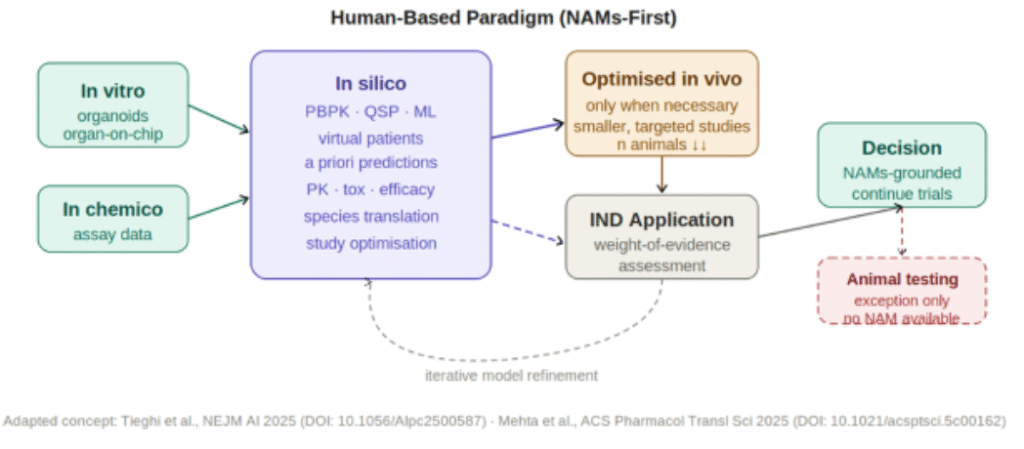
Crucially, these tools are most powerful when deployed before animal studies are designed, not after. Mehta et al. propose an “a priori in silico” workflow where in vitro data and prior knowledge first feed PBPK/QSP/QST models to generate in vivo predictions — which then guide the design of smaller, targeted animal studies rather than the reverse. This iterative loop, in vitro → in silico → optimized in vivo, is precisely the paradigm shift Tieghi et al. envision: computation and human-relevant biology driving the decision, with animal data as the exception rather than the default [Mehta et al., 2025; Tieghi et al., 2025].