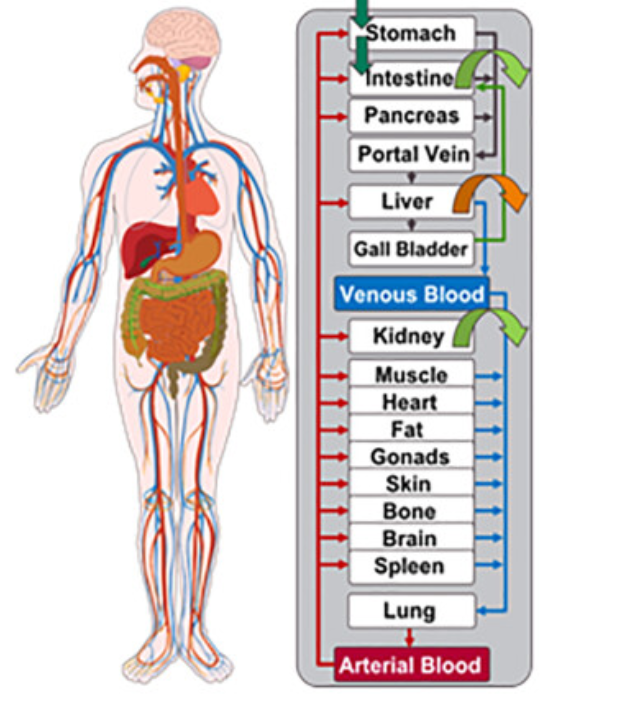
PBPK is a computational approach that predicts how a drug moves through the body—how it is absorbed, distributed, metabolized, and eliminated. Unlike traditional methods that rely heavily on animal studies, PBPK models can use lab-based (in vitro) and physicochemical property data to simulate drug behavior in humans before any in vivo testing. This makes PBPK a powerful New Approach Methodology (NAM) for reducing animal use in early drug development.
How PBPK Can Help Reduce Animal Studies?
PBPK models can be built “from the bottom up,” using only in vitro measurements and known biological information. As shown in case studies discussed Mehta et al., 2025, these bottom-up models have successfully predicted real in vivo drug levels for several small molecules and biologics. Also, as discussed, in a priori workflow, PBPK models can be built early using only in vitro and existing biological knowledge to predict drug behavior before any animal studies. By generating these predictions upfront, PBPK helps design only the minimal, most targeted in vivo studies—reducing the number of animals needed while improving study efficiency.
PBPK Can Provide Mechanistic Insights Not Feasible From Animal Data Alone
PBPK can also predict drug levels in specific organs—such as the brain, tumors, or other hard-to-sample tissues. Studies have shown PBPK models accurately estimating brain and tumor exposure where direct measurement in animals would be invasive, limited, or impossible. This helps researchers understand drug behavior while avoiding difficult or high-burden animal procedures.
Even More Insightful When Combined With Advanced In Vitro Systems
PBPK can become even more useful when paired with modern in vitro technologies such as organ-on-chip systems. These systems generate human-relevant data that PBPK can translate into whole-body predictions. For example, combining liver-on-chip data with PBPK has accurately predicted human drug clearance and variability across different individuals [Aravindakshan et al., 2025].
PBPK: A Robust Tool NAM for Preclinical Development
Together, these features make PBPK one of the most practical and ready-to-use tools in the NAM space. It supports smarter, smaller, and more ethical preclinical study designs while improving confidence in human-relevant predictions.